Testimonials from Workshop on Teaching Literature in High School Classrooms

On January 9th, we led a workshop at the University of the Pacific in Stockton on creating critical thinkers through the study of literature.

The workshop was based on our book, and focused on the following:

  • The rationale for using quality literature (fiction, poetry, drama, and literary nonfiction) in the middle and high school English classroom.
  • Strategies and activities for introducing and implementing close reading, using George Saunders’ short story “Sticks” and the lyrics of Billie Holliday’s “Gloomy Sunday” as examples.
  • Increasing the quantity and quality of rigorous student writing.

We will be conducting a similar workshop at the 2017 CATE (California Assoc. of Teachers of English) Conference, February 17-19 in Santa Clara, CA.

The following are some testimonials from our wonderful participants:

“Very engaging! I wish more teachers would attend! As an administrator, it is enlightening to see solutions to bringing critical thinking to the classroom through literature.”


“So many great things in this workshop. I want to try everything TOMORROW!!! Thank you so much!”


“Extremely informative and useful. I found and will implement at least three strategies (close reading, on-demand writing) that I will use right away. Thank you!”


“This information needs to be shared with our curriculum director!”


“Thank you for all of the methods that I can use in the classroom. As a new teacher with no experience, this information is extremely helpful.”


“Really effective and simple strategies. As a first year teacher, I would strongly urge my undergraduate peers to check out this presentation and the Method to the Madness book.”


“Informative and entertaining, with plenty that will be useful in the classroom.”


“Thank you. Workshop went by quickly and had great, engaging, purposeful information.”


“We were offered many examples/useful samples of student work and activities. We can use this material in the classroom for planning—especially how to increase writing.”


“Y’all are amazing.”

Teaching “Native Son” by Richard Wright (Part One)

Specific materials for the following lessons are available in our Teachers Pay Teachers store.

For the past two years, I have had the pleasure of teaching Richard Wright’s 1940 novel, Native Son, to high school seniors.

I did not choose this book. I “inherited” the senior IB English classes from an excellent, veteran, and now retired teacher (and good friend), Susan Halseth. I also inherited from Susan her reading list, and teaching the books with which she filled her syllabus, Native Son included, has been a delight.

The intent of this post is simply to share some of the strategies and lessons I’ve used the past couple of years to teach Wright’s novel.

PUTTING NATIVE SON IN CONTEXT

With any novel, a good place to begin is helping students place the book in its larger context (where and when).

With Native Son, I start with something rather informal. I write the years 1919, 1929, 1939, and 1945 on the board, spaced out a bit. Then, maybe in a different color, I add in, chronologically, the year 1940, labeling it as the year that Native Son was published. Then, in pairs or groups, students identify and discuss the significant historical events that surround the novel (respectively: the end of WWI, the beginning of the Great Depression, the beginning of WWII, and the end of WWII).

This is a great way to help students make connections between the literature they are reading in their English classes and the content they have learned in their past or current History classes.

GROUP RESEARCH PRESENTATIONS

After this initial discussion of the novel’s context, we move on to something more formal.

Students are divided into groups, and each group is assigned one of the following research topics (each of which includes subtopics):

The Red Scare (in U.S., first and second)

            -Communism

            -Marxism

South Side Chicago

            -Segregation/ghettos/housing policies

            -Hyde Park

The Great Migration

            -The Black Belt

            -The Harlem Renaissance

NAACP

            -origins

            -NAACP in the 1930’s

Scottsboro Boys

            -who were they and what happened to them

            -similar cases or incidents

Richard Wright

            -literary career

            -ties to Communism

Naturalism (literary movement)

-origins

            -characteristics

            -major authors

Each of these topics will help a student reading Native Son to better understand the novel, and each group will spend a day or two (or three) researching their assigned topic and preparing a 10ish minute presentation to the class.

[Note: my students use Google Slides when preparing presentations. Here are some benefits of that: 1) All group members can be working on the same presentation file simultaneously, so everyone has “something to do.” 2) Students don’t need a subscription to Microsoft Office to work on the PowerPoint at home; they just need the internet, and there’s a smartphone app available for free. 3) When the group presents, I’m not seeing the presentation for the first time; I have been able (because the presentation was shared to me) to “check in” on the progress of the presentation as it was being developed, and I’ve been able to give feedback while the students were working on it. 4) No more, “I forgot my flash drive; can I present tomorrow?”—it’s all in the cloud.]

As each group is conducting their research and preparing their presentation, it may be necessary to give the group researching naturalism a bit of extra guidance and support, as it can be a complex topic. For an accessible definition of naturalism, see the quiz below.

Another group that may require extra attention is the group of students researching housing policies in South Side Chicago. This will be a key topic when it comes to helping students understand the naturalist view of Bigger’s character and his actions. In fact, in the third section of the novel, Bigger’s defense lawyer, Boris Max, makes an argument that housing policy is in part responsible for Bigger’s situation.

South Side Chicago in the 1930’s was segregated, but it was not segregated because of explicit segregation policies; rather, segregation was the result of housing policies such as redlining and contract selling—policies that were in place in many American cities and the effects of which are apparent today.

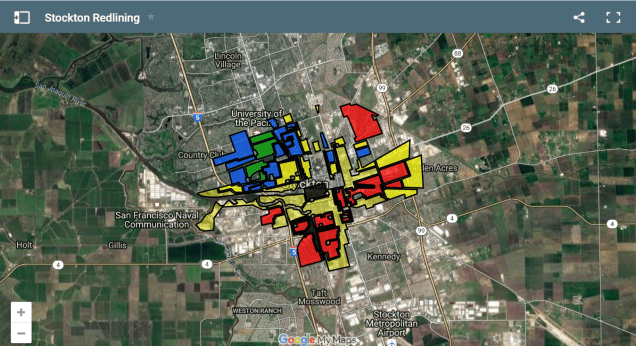
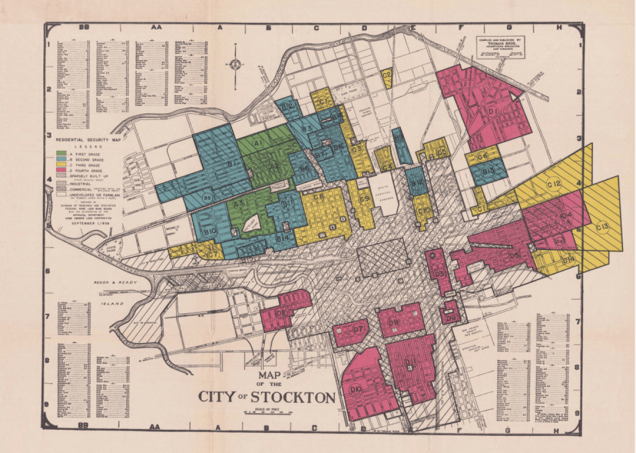
In fact, the city that I and my students live in was redlined, and students have access to a map (from the website of data artist Josh Begley) that shows the housing zones in Stockton at the time in which Native Son is set:
redlining-stockton

map-stockton-redlining

These maps allow students to make a personal and authentic connection to the novel, as many of them live in or around the redlined areas, and they have first-hand experience of the effects of those policies today.

ORAL PRESENTATION RUBRIC

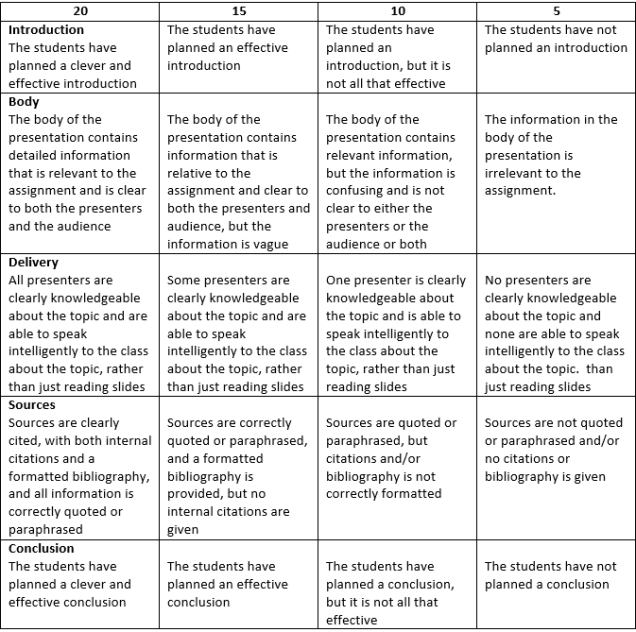
Below is the rubric that I use to score the student presentations (which they are given beforehand). It is a version of the rubric that I use for all such presentations. I made it a few years ago, and it was specifically designed to eliminate things that bothered me about student presentations, such as…

…students going up to present without any idea how they will begin or how they will end.

…the sense that the group copied down information they don’t understand and now are asking the audience to do the same.

…the sense that one or two students did all of the work and then gave the other students slides or cards to read.

…students reading slides instead of talking to the audience.

…the sense that some students, while presenting, are seeing (or reading) these slides for the first time.

Another thing that I like about this rubric is that it requires students to practice citing sources parenthetically and correctly formatting a works cited page.
oral-presentation-rubric
After the presentations, during which students take copious notes (we use Cornell Notes) and are encouraged to ask questions, the class is given the following open-notes quiz:

NATIVE SON CONTEXT PRESENTATIONS QUIZ

Richard Wright was a naturalist writer.  Naturalist fiction explores the effect of external forces—particularly a person’s environment—on a character’s psychology.

As a result, characters in naturalist fiction often feel a lack of control as a result of their environment.

Discuss the extent to which external environmental forces are driving the actions of Bigger Thomas.  Refer to as many of the following factors as possible in your response:

  • South Side Chicago
    • Segregation/ghettos/housing policies
    • Hyde Park
  • The Red Scare
    • Communism
    • Marxism
  • The Great Migration
    • The Black Belt
    • The Harlem Renaissance
  • NAACP
  • Scottsboro Boys
  • Richard Wright’s own life experiences


In the next post on teaching Native Son, we’ll focus on the effect of Wright’s choices regarding point of view and on themes and motifs in the novel.

Teacher Appreciation Day at Face in a Book

We will be discussing and signing copies of Method to the Madness at Face in a Book in El Dorado Hills, CA as part of their Teacher Appreciation Day on January 19th.

We will be there from 4 to 6 pm, but teachers can receive 20% off any purchase (plus special treats and gifts) all day.

We’d love to see you there!

The Argument for the Incorporation of Short Fiction into the English Classroom (Or: There Are No Silver Bullets in Education [Except Maybe This One, and We Should All Be Doing This])

The following is a speech given to the Delta Kappa Gamma sorority by Elizabeth James, co-author of Method to the Madness: A Common Core Guide to Creating Critical Thinkers through the Study of Literature:


Method to the Madness is, in essence, a return to the old school way of teaching English. It argues for an increase in the quantity and quality of student writing.

Nowadays, it is not uncommon for students at the high school level to read only one or two texts a year in their core English class. This means a student can have been exposed to ONLY FOUR texts by the time they graduate high school, which is, of course, completely unacceptable.

This is because of

  1. Attendance issues—teachers can’t get through material because students are not consistently all in the room at the same time.
  2. Reading the book in class—a problematic exercise that results from not trusting students to read on their own or not trusting students to return to school the next day with their books.
  3. Focusing primarily (sometimes exclusively) on plot, therefore sluggishly turning pages and taking chapter quizzes, sometimes at the cost of having a classroom that feels urgent and fast-paced.

Here’s the problem: though I can understand each of the above reasons, they create an environment where not enough reading is taking place and that which is taking place is designed to feel like a chore.  It is a design that does nothing to create readers.  People who love to read don’t read like that: one book a year, waiting for everyone to catch up so they can turn a page, days between reading sessions.

So here’s the first step to the silver bullet we’ve all been missing: we should teach literature the way we came to love literature ourselves.  When I think of how books and storytelling and later analysis and criticism became fascinating to me, I have no memory of worksheets. Or plot diagrams.  Or vocab homework.

I remember characters, and life changing teachers who spoke with passion, and hearing or reading something that–all of a sudden–made the world make a bit more sense. This is what we should do for all students.

Often, school districts and the powers that be (rightfully so) start searching for avenues of access for the struggling students.  How, in a district with high levels of poverty, low levels of academic achievement, and high levels of teacher turnover, can we get below grade level students up to speed and competitive?

In practice, this often becomes the moment when we start deciding what THESE KIDS can handle, and that’s the problem. As soon as we have decided that THESE KIDS need something different from high achieving students, these kids are being taught as problems, not solutions.  This manifests itself in several poor teaching exercises. Giving low readers pamphlet excerpts about Yosemite National Park won’t make them better readers. Having units entirely designed on how to design a resume for Blockbuster won’t make them better readers.  Bubble tests won’t make them better writers. Buying truckloads of condescending, POORLY WRITTEN fiction designed for struggling students isn’t any good, and does more harm than not.  I’ve taught these classes and worked with these students and been given this curriculum, and the first major lesson is as soon as we treat them like struggling students they perform like struggling students. You can’t have some students in 10th grade doing a unit on Shakespeare, and some 10th graders doing a unit on resume writing, and have them not know what their school thinks of them.  They know.  And that’s when they stop trying.

Why don’t we flip the paradigm, here?  Why don’t we teach struggling students the EXACT same way we teach high-achieving kids?  Why aren’t the struggling students being asked to read more, write more, think more, just as we challenge our students in our top classes to do? Why is our instinct to make the subject matter as boring and sometimes even offensively transparent as we do? Why don’t we provide thought-provoking, high stakes literature? And trust them to write about and create their own?  And why don’t we teach students who do not yet know the love and comfort of the written word the same experiences that brought us to that love?

The second part of this silver bullet is simple.  Increase the amount of critical reading and writing your students will be exposed to. For this, I would like to create the argument for the inclusion of the contemporary short story.

Short stories often don’t get taught because they aren’t in the book room or in the textbook—what is there is often the watered down, lesser work of great writers.  The exclusion of short stories in our syllabus, however, ignores what the texts offer:

  1. a variety of written voices and authors—women (!), different ethnicities(!), perhaps even people who are still alive!!!! Think back to the idea that lots of American high schoolers are graduating with diplomas after being exposed to just four books.  That’s four authors.  That’s four potentially different styles/genres/etc.  However, chances are they will meet four white writers from the Romantic or modernist age, probably in novel form.  That’s fine, those texts are amazing, but if you are a student who is constantly receiving the message that they aren’t very good at “this stuff”, it isn’t helpful to also message that “this stuff” sounds like a hundred years ago (minimum) and it’s their fault if they don’t get it.  Again, why on earth do we meet struggling students with such a limited example of what storytelling means to them? Ridiculous.
  2. great literature that attendance and pacing issues no longer affect. Many of these stories can fit on a page or two, and therefore, reading in class becomes no problem.  Missing a class doesn’t mean you cease to understand what is happening in the text.

Let me provide an example.  A couple of years ago in my first-period class, I had a student who was perpetually twenty minutes late.  This is because she had to take her little brother to his school in the morning before she could make it to her class.  This was, of course, problematic in a sixty-minute period, and was a larger problem that needed to be addressed.  But in the immediate sense, she was a student trying extremely hard who always was a little behind everyone else.  Instead of missing twenty minutes of reading time, when we were in the short story unit, she could take two or three minutes and know what everyone was talking about.  She could participate meaningfully in the class.  She could jump in when she got there and contribute and challenge herself.  Her external situation was not interfering with her internal participation and learning.

Students who are often late or absent are not necessarily excluded from the enjoyment and study of the literature.  It becomes less about keeping up with the reading, and more to do with engaging with the reading—a much higher level skill.

You can teach all the skill without losing momentum by turning pages. Need a unit on figurative language? Subtext? Inference? Word choice? Characterization?  You don’t need a novel to get there.  Junot Diaz or Lori Moore can do it in ten pages.  And the level of writing is stunning to students of all abilities.

A quick note about that.  A few years ago, I was team-teaching with my husband, and we did a really immersive short story writing unit.  It was a way to make students practice those standard words that so often come up on exams: voice, inference, dialogue, theme, etc.  Instead of merely recognizing the strategies, by writing their own fiction they had to create these terms in their original stories.  At the end, we offered the winner of the best short story collection (chosen by a panel of teachers at our site) a Barnes and Noble gift card and a copy of Junot Diaz’s Drown. That collection of short stories has been purchased by our household no fewer than four times because every time we read from it to our classes, it gets borrowed (or, at least once, lifted) and the students can’t bear to give it back.  This has never happened to me in the case of Harper Lee or Huckleberry Finn.  It’s not that those aren’t just as good—of course they are—but they don’t surprise the hell out of students the way Junot Diaz does.

Don’t misunderstand me; this silver bullet of contemporary short fiction doesn’t end with the replacing of traditional reading lists or the elimination of anything pre post-modernism.  Of course not.  I would argue Hamlet is just as relevant to a teenager’s life than any contemporary short story I could offer.  That’s why they are the great works of fiction: they transcend time and place and continue to speak to us.  I only offer the possibility that the problem here, in large part, is the need to change the paradigm of expectations.  Struggling students must be reading and writing so much more than they are expected to right now.  And that expectation of them must be met by us, the teachers, with the commitment to provide them interesting, challenging works of art that will show them just how important it is to know how to tell their story.

CATE Conference 2017

For anyone who is planning to attend the California Association of Teachers of English Conference February 17-19 in Santa Clara, we will be presenting a workshop on creating critical thinkers through the study of literature.

The session is based on our book and will provide strategies for middle and high school English teachers to increase rigor and inquiry in their classrooms–and meet the demands of Common Core–through the close study of quality works of literature.

The workshop will take place on the first day of the conference, February 17, from 9:15 to 10:45 am.

We hope to see you there!

cate2017logo-teal_-768x202

Holiday Sale! 35% Off Orders of Method to the Madness!

Get 35% off your order of Method to the Madness: A Common Core Guide to Creating Critical Thinkers through the Study of Literature by using this code: RLWEB3516

Go to https://rowman.com/ISBN/9781475825374/Method-to-the-Madness-A-Common-Core-Guide-to-Creating-Critical-Thinkers-Through-the-Study-of-Literature

Sale ends December 30th!

Married Couple Abandons Parenting for 3 Months to Write Book

This post was originally published on the blog of B.H. (Bill) James, one of the co-authors of Method to the Madness: A Common Core Guide to Creating Critical Thinkers through the Study of Literature:


Potential headlines for this story:

Married couple writes book.

 Married couple writes book in only 3 months.

 Married couple abandons parenting for 3 months to write book (ultimate winner).

Married couple surprised by how little they come to hate one another while writing book in only 3 months.

Married couple, as side effect of co-writing book in 3 months, becomes those people at Starbucks with all their computers and cords and stuff and about whom you wonder Don’t they have a home?

Parents of infant and toddler who placed ad in search of parents found at local Starbucks, indexing.

A few weeks ago, I wrote a post titled, Things that Have Happened Since the Last Time I Posted on My Blog, in which I singled out five things:

Thing #1: I quit blogging.

Thing #2: I had a second kid.

Thing #3: I (we) took first kid and second kid to Disneyland. Twice.

Thing #4: I wrote a book with my wife.

Things #5: I was informed I have high cholesterol.

In that last post, I went into more detail about Thing #1 and Thing #2. This is Part 2 of that post and will be about Thing #4, skipping Thing #3 for the time being, just because.

Thing #4: I wrote a book with my wife

A full explanation of the book’s intent and the impetus behind it is explained here.

So we (Liz and I) had this idea for a book. We’re both high school English teachers, and it’s a book about teaching high school English.

The idea started out as a book about teaching Slaughterhouse Five, the idea later expanding to a book about teaching Slaughterhouse Five as well as half-a-dozen other books we like to teach.

We batted it around for six months or so, getting serious enough from time to time to draft some chapters and eventually reaching the point at which we began to think about the possibility of submitting it, at which point we learned about book proposals.

So we spent (spent should be precisely defined here as referring to no more than ten to fifteen minutes every few days scratched [into? out of?] an at-home schedule dominated by parenting and grading and Netflix) the next six piecing together a book proposal, which included a query letter and an overview and an annotated table of contents and market research (I say included market research not actually knowing by any degree what market research is and therefore whether or not what we did is it but anyway we analyzed who/what our market is and other books for which the market is the same and how our book was/was not similar and etc.) and a sample chapter.

We sent the proposal out to a handful of education publishers, from which we received rejections, some of which were non-form and encouraging, before finally hearing from a very nice acquisitions editor at Rowman and Littlefield named Sarah (in fact, R&L had been suggested to us by one of our previous non-form and encouraging rejecters).

Sarah asked for some additional materials and some revisions to the sample chapter and then needed to take the proposal to the editorial board. A few days later, she wrote back with an acceptance. We were delighted.

Here’s the said-sarcastically-fun part. Sarah’s acceptance came on July 23rd of 2015. In the same email, Sarah expressed that it would be an advantage for the book—though it would not yet be published—to have an ISBN number and be promotable at the NCTE (National Council of Teachers of English) conference that November, and for that reason Sarah wanted to know if we could submit to her the final manuscript by early September (this would later be extended to the first of October).

Now, at that point (July 23rd), we had the sample chapter and a couple of other very rough and incomplete chapters, all amounting to less than fifty pages.

We also, at that point, had a nearly-three-year-old and a nearly-three-month-old, as well as full-time jobs: me teaching and Liz at home with the kids, Liz having taken leave from that upcoming school year. I also had a part-time teaching job some evenings and Liz also was working on her Master’s degree.

But I had this memory from grad school of one of the faculty members, a novelist who also wrote screenplays, giving the advice, said advice delivered within an anecdote about a screenplay, that the answer is always, Yes! Like, for example, if “they” ask you if you happen to have any stories/manuscripts/screenplays/whatever about bla bla bla, you always answer Yes, and then go write a story/manuscript/screenplay/whatever about bla bla bla, and it was with this anecdote with its embedded advice that I convinced Liz that despite the apparent impossibility of pulling it off we should just say Yes!

So we did.

For the several months that would later follow the book’s release, when people would ask something along the lines of How’d you do it, I would repeatedly give the same jokey answer: “We just quit parenting for 3 months and did it.”

But we didn’t really quit parenting or abandon our children–Liz in fact clutched our three-month-old and declared that we could not let this affect our time with the kids–though we did for a time parent them less.

We wrote early in the morning. We wrote at night after bedtime. And for a rather large chunk of each of about twelve consecutive Sundays we got a babysitter and went to our local Starbucks.

Things you notice when you spend 10 or more hours per month at your local Starbucks:

  • Much like Walmart, people will wear almost anything to Starbucks.
  • In any span of several hours at the local Starbucks, a lot of people come and a lot of people go, but the four or five people who remain through all of those hours are pretty much the same four or five people who are also there week after week.
  • If you are one of those four or five people, location is everything, and the ideal location depends upon your purpose. For some, it’s those comfy chairs. For us, it was a balance of table space and access to a power outlet.
  • Though you may not start out there, if you stay at the local Starbucks long enough and if you’re willing to repeatedly pack up all of your stuff and move, you will eventually get your ideal spot.
  • If there are two of you, and you each have a laptop and papers and books, you may very likely need to initially split up, but you will eventually (see above) reunite.
  • Starbucks food seems wholesome and even kind of high-end. And you get the impression that they (Starbucks) don’t even really see it as food people would regularly eat, like at McDonald’s, but food people get to go with their coffee or food people need because they’re starving after waiting in line so long for coffee. It seems more like premium food.

But it’s not. In reality, it’s food taken out of a plastic package and put in a microwave, which is what you get when you eat at a gas station (which I happen to know a lot about), except at the gas station you do the microwaving yourself, and when you eat enough re-heated Chicken Artichoke on Ancient Grain Flatbreads, they just start to taste like gas station food.

My first book took three years to write. All the same things happened with this book—frantic drafting with the recurrent thought that nothing that I am typing right now can ever be in a book in fact it’s so awful it can never ever be seen by anyone ever; never-ending laborious revisions such that one reads the same chapters and the same pages and the same paragraphs and sentences over and over and over again; that feeling that when this is over I never want to read or see or even think about this book ever ever again in fact I’m never going to do anything difficult with my free time again just Netflix and ice cream from now on. All the same stuff, just this time crammed into 3 months.

But it all worked out. We finished. On time. And the people we need to thank are: Sarah; our babysitter, Lizzie; our two readers, Susan and Ellen. And of course our kids, for getting along without us for a while.

The Lit-Farm Project

Laurie Gates, whom we met at an event for Method to the Madness at the Avid Reader in Davis, CA, mentioned the book in a recent post on her blog:

“Many thanks to both B.H. James and Elizabeth James for their outstanding book Method to the Madness: a Common Core Guide to Creating Critical Thinkers Through the Study of Literature which inspired me to find a name for my vision and an increased sense of determination to try to make it happen. Their energy and enthusiasm are very refreshing and so very needed!

Finally, special appreciation to the Stockton high school students who contributed such insightful literary essays to the book. Hats off to you and keep up the great work.”

Thanks, Laurie! You can read about her amazing Lit-Farm project here.

Preface to “Method to the Madness”

The following is the preface to our book, Method to the Madness: A Common Core Guide to Creating Critical Thinkers through the Study of Literature.

The book was published in 2016 by Rowman and Littlefield, and can be found at…

https://rowman.com/ISBN/9781475825374/Method-to-the-Madness-A-Common-Core-Guide-to-Creating-Critical-Thinkers-Through-the-Study-of-Literature

https://www.amazon.com/Method-Madness-Creating-Critical-Literature/dp/1475825382

http://www.barnesandnoble.com/w/method-to-the-madness-b-h-james/1123147454?type=eBook


Preface

Six years ago, we were each hired to teach a summer school creative writing course in our district.  Our classrooms were across the hall from each other.  There was no curriculum provided.  No pacing guides.  No mandated test.  The course was designed to be credit recovery, full of kids who had failed an English class the previous year.  By working collaboratively that summer, we created a course that was both rigorous and a lot of fun—for the kids and the grown-ups alike.

The students in our classes read great literature—both classic and contemporary—and analyzed the craft of that literature.  And they wrote.  A lot.  And they shared their work and scrutinized their work and revised their work.  We didn’t keep track then, but the following spring, when we duplicated the same units in our 10th grade classes, we did keep track, and those students (roughly 100 of them) collectively generated approximately 10,000 pages of original and revised fiction over the course of one quarter.

There was a third creative writing teacher that year in summer school.  Her kids were, according to her, too noisy, not smart enough, just there to hang out, and quickly driving her crazy.  What was she doing in class?  Diamond poems, acrostic poems, poetry worksheets—the sorts of things you might expect to see at a second grade back to school night.  That was when it began to become clear—what was the difference?  Why were two of the classes that summer working—and working hard—and one wasn’t?

We had no previous rapport with the students—summer school wasn’t on our site that year—so these kids had never been in our rooms before.  All three classes were populated by students who had failed English classes in the past.  All three were full of students that were not necessarily fast-tracked for success.  The difference, really, was strikingly simple:

We were teaching them things that were interesting—to us, as readers.  And through our enthusiasm and desire to discuss—deeply, analytically—what we found interesting with our students, they became interested, as well.

Why, as educators—as people who presumably love learning—do we so often abandon what made us “nerd out” as students ourselves, and instead prescribe to our students boring and/or substandard reading—most likely prescribed to us by a school board or a publisher—to kids who are struggling with writing and reading?  Taking an underachieving urban school, similar to the one we taught in at this time, you can probably count on a few things in that school’s textbook room:

  1. Big, thick, heavy textbooks that include everything the student will read (or will be assigned to read but won’t read) that year. First of all, who wants to curl up with a book that weighs about the same as a sandbag?  Second, it has been our observation that such books include second rate (and safer, and shorter) works by really great authors.  Finally, an anecdote: several years back, when districts spent a whole lot of money on textbook adoptions and teachers were subsequently expected to be spending every minute teaching those text books, the 9th grade English text included Act II of Romeo and Juliet.  Just Act II.  The notion then being that 9th grade teachers would initiate their often-below-grade-level students to the rich and varied world of Shakespeare by teaching Romeo and Juliet, Act II.  Just Act II.
  2. A collection of short (and often short on craft) novels about a young kid from the streets who wants to be a basketball player, or something similarly cliché, the notion here being that the only way to get struggling readers who don’t want to read to read is to give them something they can relate to. Like the streets.  Or basketball.  If this seems in any way demeaning, we agree with you, and don’t believe for a second that the students aren’t aware of it.  You know what’s even more relevant to their lives than the streets or basketball?  Every play Shakespeare wrote, and it’s our job to show them how.
  3. Stack after stack of quality novels and plays shoved in a corner, gathering dust, because “these kids can’t handle books like that.”

What we have found was that when we spent time talking about and thinking about literature that personally affected us, we had a much stronger motivation to teach the skills associated with that literature, and teach them well.  In contrast, it can be difficult to find the motivation to design an engaging lesson around reading an instructional manual.

Great literature—along with the skills required to read and appreciate it—is interesting to us, English Lit nerds, and through our enthusiasm it therefore became interesting to our student population.

The following year we were assigned to team teach at the 10th grade level.  We took the opportunity to overhaul the reading list.  Our criterion was books that students should read before getting to college—the books smart people will be talking about. That year, the list consisted of The Sun Also Rises, The Things They Carried, Slaughterhouse Five, 1984, The Great Gatsby, Death of a Salesman, and Macbeth.

We took that year to test our hypothesis: could you take 180 students of various ability and various backgrounds and find success by mirroring the type of work you would see in a college-level English class.  We did our homework—a lot of homework, it turns out, which we used as an opportunity to model for the students.  We would bring in our notes and a stack of literary criticism we’d pored through, and would show them that to prepare these lessons, we had had to study up.  They appreciated that.

We used itunesU lectures from Yale and Berkeley and Harvard to demonstrate that the things they were discussing in class were the things that people were discussing at the top universities.  They appreciated that, too.

Though not every student loved every text, by overhauling the reading list and creating a new syllabus that reflected a variety of different themes, voices, and styles, students were exposed to a plethora of choices for reading—something they’d never had before.  That was also appreciated.

Turns out it works.  That year, and those subsequent to it, have taught us over and over again that it doesn’t matter who is in the room.  What matters are the teacher’s high expectations and thoughtful assessment.  What matters is how you create a dynamic classroom when talking about books.  And frankly, what matters is a thoughtful consideration of what texts offer powerful voice, complex ideas, and good story telling.

A word about student population.  We are International Baccalaureate trained teachers.  IB is a program renowned for its rigor and high expectations, but we have also taught non-IB college prep courses, English language learner courses, and intervention courses.

By reevaluating our delivery of instruction and the content used, students in those courses have been extremely successful.  They weren’t going to become critical readers by reading travel brochures, as prescribed by some of the curriculum designed for them, but they did become better readers when given quality literature that was worthy of discussion.

In short, it shouldn’t matter who your student population is.  You tailor your delivery to the students in the room, but that doesn’t mean you should condescend to your audience.  They may do the work, but they won’t love it, and if we want them to be hungry for success, they have to believe in what they are doing.

We were fortunate to begin our teaching careers in a magnet program in which we were expected to design our own rigorous curriculum centered on literary works and designed to prepare students for rigorous essay-based exams.  Meanwhile, many of our colleagues were held to the demands of state or district mandated pacing guides and standardized testing schedules, with little room for rigorous curriculum design by individual teachers.

With the onset of common core, with its emphasis on critical thinking and logically developed writing, we thought we may have some relevant experience to share.  What follows is a breakdown of how we approached our English classes.  Everything in this book we’ve used.  Everything in this book we created.  We believe that if English teachers would take up this challenge, allow this core class that all students are required to take be a lot tougher, a lot more rigorous, with a lot more writing, and if they would use good books—not just what they like, but good, quality, art—what we would have are scholars who (even if they aren’t bound to be English majors) will appreciate the choices artists make, and will be happy to discuss those choices with you.